
Strategy Session Spark: How Otherwhere Turns Ideas Into Creative Fireworks

Photo by Mikhail Nilov on Pexels
A strategy session could be one of the most powerful tools in your organization’s arsenal that can help your business spark innovation and move with intention. While most people would consider running a strategy planning session necessary only when planning a product launch or defining their next quarter's milestones, it is also useful for even short-term goals or daily tasks that require more direction.
As a creative studio, Otherwhere incorporates the essential aspects of strategic sessions into our planning to transform our bursts of inspiration into something more structured. For us, a well-designed strategy serves as the backbone of meaningful progress to small businesses and large-scale organizations alike.
Conducting a strategic planning session might conjure images of rigid agendas, stale coffee, and text-heavy presentation slides in your mind. The truth? Strategy does not always need to be too stiff or by-the-book, and actually, it shouldn’t be. At Otherwhere, we’ve learned that among the most effective strategy sessions are equal parts structure and freedom. Where there is clarity, there should also be room to grow and let your imagination run wild. By thinking out of the box, you can come up with unique ideas that lead to awe-inspiring and purposeful insights.
While there is no single perfect formula, there are proven structures that make strategy sessions more effective, energizing, and genuinely impactful.
In this blog, we aim to share our best tips on facilitating a strategy session that could help you deliver results while also sharing glimpses of how we, in our quirky Otherwhere manner, make it inspiration-driven and whimsical in our own little ways.
Begin With a Clear Strategic Intention

Photo by Vitaly Gariev on Unsplash
Without a clear intention, even the best strategy session preparation will turn into a brainstorming mess. It is important to have a common, agreed-upon direction to ensure that your ideas will harmonize and lead somewhere fruitful.
You can start strong with your sales, branding, or marketing strategy session with the following building blocks:
A clear, defined purpose
A list of at least 3 intended outcomes or results
A brief description of what decisions you and your team have to make together
Most importantly, a measurable and definite understanding of what success looks like by the end
These fundamental steps help prevent conversations from spiraling, cause confusion among team members, or spark motivation loss.
At Otherwhere, we ensure that we share a pre-session brief that includes both our objectives and expected results. We typically use “creative energy cues” such as playful and true-to-the-brand colors, textures, strategic moodboards, and other thematic notes to set the emotional tone. This keeps participants not only informed, but also inspired. This has proven even more useful for remote teams that conduct a virtual strategic planning session. Visual cues can help anchor understanding and clarify direction compared to just using plain language alone. For us, a single image often translates in one glance what ten paragraphs cannot.
Some visual tools you can use that we at Otherwhere also love to incorporate in our own strategic planning sessions are:
Sketches
Flowcharts, tables, diagrams
Scribbled storyboards
Rough mock-ups
Presentation or idea snapshots
Reference photos or portraits (our personal fave!)
Set the Stage with Context, Data, and Insights

Photo by UX Indonesia on Unsplash
Now that you’ve set expectations and aspirations in mind, conducting research then allows you to understand the current state of market realities, performance, consumer behavior, operational constraints, and the like. With hard, research-backed data, you and your team can then gain more useful context to help you be more focused and aligned when planning a strategic planning session.
Some key components that are recommended to be present in this phase of your brand strategy session include relevant data, statistics to back up important findings. Insights from customers and shareholders also go a long way in acquiring more context for your planning. Performance metrics are also a great way to evaluate how your business is doing and what you can improve on when running a strategic planning session. Looking at competitive analysis and benchmarks, as well as market trends, can also help you understand your target audience and what your competitors are doing to branch out to communities or get their messaging across successfully.
How we do it in Otherwhere entails ensuring that this part feels more like an honest snapshot for us, not just a polished pitch. Instead of just numbers, we also incorporate emotional insights, brand personality notes, cultural references, and other personal data that give more meaning behind the numbers and stats. For us, brands aren’t just data; they are living ecosystems surrounded by life, emotions, and inspiration. While numbers matter, intuition also matters just as much in a strategy session agenda.
Build Goals into Strategic Pillars

Photo by Clay Banks on Unsplash
After gathering relevant data and conducting thorough research, you can start building out your goals for the business strategy session. Although large-scale objectives may be quite daunting at first, knowing how to organize them strategically can help you and your team gain more clarity and efficiency.
Among the common categories that you can use to categorize your goals are:
Brand identity or refresh objectives
Messaging improvements
Performance enhancement goals
Revenue increase targets
Product or service upgrades
Operational processes or workflows
Sales, marketing, or creative goals
Marketing or creative objectives
Customer experience enhancements
At Otherwhere, doing this seemingly simple step helps us transform our goals into manageable and attainable areas of focus. More often than not, we consider a “creative transformation” pillar as a space for us to explore how a project would want to explore goals visually, emotionally, and even conceptually. This creative space helps us innovate outside a rigid strategy session template and even acquire community connection goals that stay true to our brand and vision. After all, corporate objectives can always be translated into creative language to help activate imagination and come up with more innovative aspirations.
Ideation Techniques for Strategy Session Planning
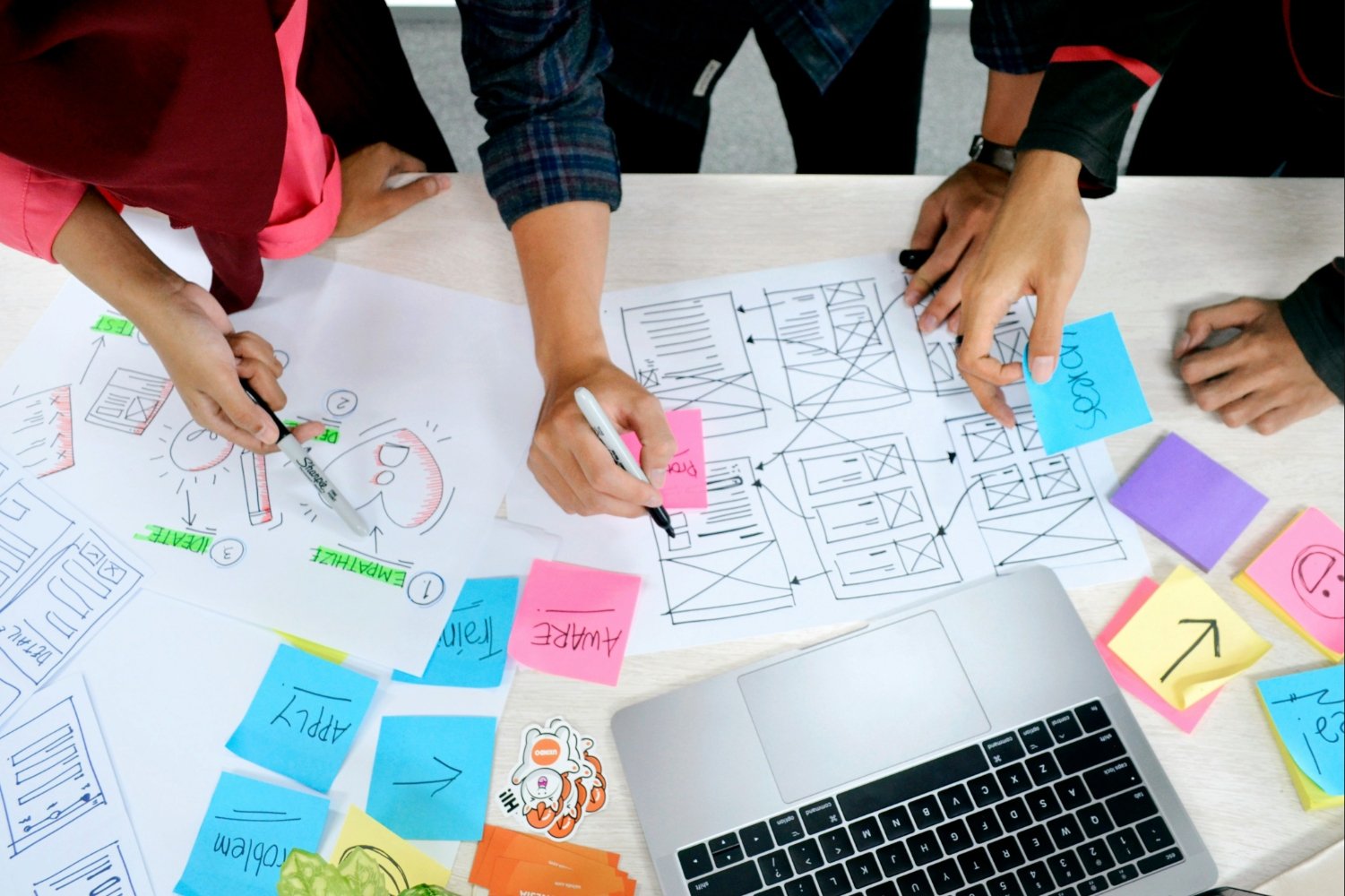
Photo by UX Indonesia on Unsplash
While open-ended questions during a brainstorming session can be useful, structured marketing strategy sessions or even those that focus on revenue, sales, or general planning meetings always prove to be more effective. This is most especially true if your team is working on a tight deadline or aiming to get your target objectives reached in the best way possible.
You can draw systematic ideation techniques from:
SWOT (Strengths, Weaknesses, Opportunities, Threats) Analysis
Journey Mapping
Impact vs. Effort Matrix
POV or Role-Playing
Mind Mapping
Design Thinking Prompts
Just because you want your insights to be structured, it does not mean that you cannot think outside of the box and let your playful side shine. In fact, our creative studio goes beyond these methods by framing our prompts in imaginative ways: structure first (to keep us grounded), and whimsy second (to keep us open). For us, this combination has been surprisingly, but pleasantly, effective.
Systematically Vet Ideas
Asking the right strategy session questions can lead to inspired ideas. The challenge, though, is that even the insights that serve a great first impression still need to be assessed carefully. To prioritize and evaluate your ideas systematically, you can use common evaluation criteria such as cost, impact, risk level, feasibility, timeline, goal alignment, or resource availability.
Otherwhere’s scoring system also helps us turn abstract concepts into prioritized decisions. With a simple “absolutely yes” or “not right now, but compelling” categorization, we ensure that no idea gets thrown to the wayside. We firmly believe that innovation thrives where ideas are archived, but not totally distracted. We keep our valuable insights that prove to be useful and applicable for other projects that we work on in the future. This helps us save not only effort, but also well-earned time and money.
Lights, Camera, Action Plan!

Photo by Vitaly Gariev on Unsplash
What is a strategy session without a tangible action plan to transform your inspired ideas into success? While we’re all about artistic daydreaming, we also value businesses’ need to attain their accomplishments as a team. Keeping the momentum alive with an action plan should include clear next steps, final key decisions, owners of each task, tools and resources required, timeline expectations, hard deadlines, and next steps. One thing that often gets overlooked with action plans is scheduling the next follow-up meeting. A scheduled follow-up session helps drive accountability and inspires progress among strategy session participants.
Like other elements of an effective strategic meeting, an action plan does not have to be too fixed or rigid. For instance, our studio loves making roadmaps with a creative twist where we blend strategic clarity with visual direction or emotional tones. Even a strategy storyboard that mixes action steps with execution phases turns it into a campaign blueprint with personality and voice.
Confirm, Commit, Succeed

Photo by fauxels on Pexels
Before finally wrapping up your strategy session, effectively summarizing alignment helps you ensure that your team leaves with clarity instead of assumptions. No matter how great your ideas are, misalignment after your meeting can result in wasted effort, confusion, and even the need to rework everything. Make sure to reconfirm decisions, revisit your primary outcomes, double-check task owners and deadlines, and establish shared accountability. Most importantly, ask your participants questions when leading a strategic planning session - especially at the end of it. This helps recap major takeaways, build rapport, and establish trust among your team. After all, emotional alignment is important in attaining goals together, too.
So, What’s the Most Effective Strategy Session?
There is no one perfect solution or approach to attaining the most effective strategy session. However, blending clear purpose, data-driven insights, structured ideation, evaluation frameworks, and actionable outcomes can better your chances of achieving collective alignment and ultimately the success that your team or business needs.
Beyond structure or research, honoring your team’s imagination, flexibility, and personal insights can also help you draw inspiration to come up with innovative ideas and goals. At Otherwhere, we live in the sweet spot between the technical and the whimsical. Our strategy sessions are grounded enough to ensure progress, but also playful enough to spark ideas that no rigid agenda could ever produce. In the end, strategy isn’t just about defining the path - it’s also about shaping a future worth creating.
We’ve helped brands transform chaotic sparks into clear, confident direction—and we’d love to do the same for you. Reach out to us, and let’s make your next strategy session unforgettable!
